
Understand AI-generated codeCompare. Diagnose. Improve.
Give several code generation models the same programming or data-science task. CGM Comparator runs each result in a sandbox, scores it, annotates it, and lets you refine and compare.
The app opens on its own address. You'll sign in with the same Google account in the app.
- Sandboxed execution
- Shared test cases
- Up to 5 models per run
AI ships code fast.
Verification is still manual.
The generation gap is solved. The verification gap is not.
Multiple models, no clear comparison
Different models produce different implementations. Existing tools provide outputs — not evidence.
Manual verification is expensive
AI rewrites large code blocks, but developers still review line by line. Verification becomes the new bottleneck.
Passing tests ≠ quality code
Readability, efficiency, and trust remain invisible. Current evaluation focuses only on functional correctness.
Core Capabilities
A platform for understanding, comparing, diagnosing, and improving AI-generated code.
Understand the Code
Turn raw generations into structured functional blocks to reason about behavior fast.
Compare Across Models
See structural differences across models without reading full code line-by-line.
Multi-dimensional Evaluation
Shared test results plus efficiency, reusability and editability scores.
Guided Refinement
Apply targeted fixes with guided prompts powered by diagnostics.
Experiment History
Finished runs stay in your history with their code, scores and results.
Easy to start.
Follow a guided flow from prompt to results —
with annotation and diagnosis you can toggle anytime.
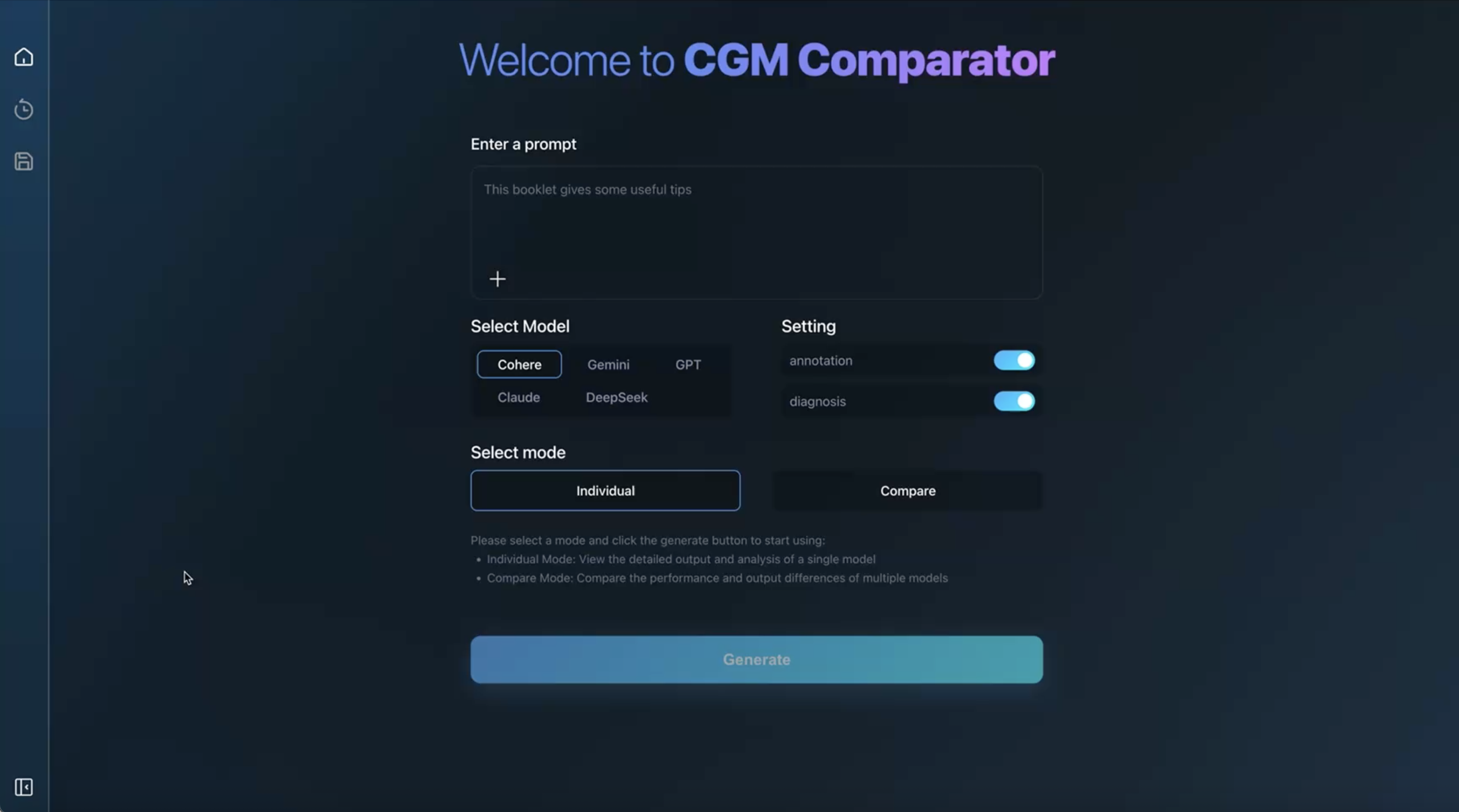
Enter a prompt
Describe your programming or data-science task. Every selected model gets the same requirement.
See how CGM Comparator
works in practice
Explore how the system analyzes, compares, and improves AI-generated workflows.
Compare implementations at a functional level
Understand how different models solve the same task — not just what they output.
- Structural comparison across models
- Functional block alignment
- Multi-dimensional evaluation signals
Reveal workflow structure and intent
Automatically segment generated code into functional units and expose execution logic.
- Functional abstraction beyond syntax
- Structured annotation pipeline
- Clear execution flow
Improve results with structured guidance
Turn diagnosis into actionable steps and refine code iteratively.
- Evidence-based diagnosis
- Guided improvement steps
- Iterative refinement loop
Functional but high cyclomatic complexity. Nested loops, unclear naming.
Logic restructured into named functions. Depth reduced from 5→2.
Vectorized inner loop. Memory cut 40%. All 50 test cases pass.
How the platform works end-to-end
A full-stack loop from prompt to evidence, diagnosis, and continuous improvement.
Interaction Layer
Where developers interact with generated code and insights.
Evaluation Engine
Multi-dimensional analysis and functional understanding of generated code.
Execution + Storage Infrastructure
Sandbox execution, result persistence, and history tracking.
Real scenarios. Real decisions.
From vendor selection to production review — CGM Comparator fits into the moment when AI code quality actually matters.
Know which model to use before you commit.
- Run the same prompt across up to five models at once
- See shared test results and efficiency, reusability and editability scores side by side
- Choose with evidence from your own task
How results are produced
What a score on this platform does and does not mean.
Tasks without a dataset
Before generation, one evaluation spec is derived from your requirement: an entry point and a set of test cases. Every model implements that entry point and every candidate is checked against the same cases.
Expected values and the comparison stay outside the sandbox.Tasks with a dataset
Each candidate script runs with your files in its working directory. The result says whether the script ran to completion. It is not a check that the analysis is right, and the app says so.
Shown as “ran”, never as “passed”.From OpenAI, Anthropic, Google, Cohere, DeepSeek.
Efficiency, reusability, editability.
One multi-model run or one refinement.
Uploaded datasets are deleted after at most 7 days.
Plans differ by credits,
nothing else.
One credit = one multi-model run or one refinement. Every plan has the same features.
Free
Free
Try the product on your own tasks.
- 10 credits, one-time
- Credits do not refill.
- One credit = one multi-model run or one refinement.
You'll sign in with the same Google account in the app.
Pro
$49/ month
For regular individual use.
- 200 credits per billing period
- Balance is set to 200 each time a billing period is paid. Unused credits do not carry over.
- One credit = one multi-model run or one refinement.
You'll sign in with Google first, then pay through Stripe. No free trial.
Team
$149/ month
A larger credit allowance on one account. Seats and shared workspaces are not available.
- 1,000 credits per billing period
- Balance is set to 1,000 each time a billing period is paid. Unused credits do not carry over.
- One credit = one multi-model run or one refinement.
You'll sign in with Google first, then pay through Stripe. No free trial.
| What you get | Free | Pro | Team |
|---|---|---|---|
| Price | Free | $49 per month | $149 per month |
| Credits | 10 credits, one-time | 200 credits per billing period | 1,000 credits per billing period |
| Refill | Credits do not refill. | Balance is set to 200 each time a billing period is paid. Unused credits do not carry over. | Balance is set to 1,000 each time a billing period is paid. Unused credits do not carry over. |
Ready to verify
what AI writes?
The free plan includes 10 credits and needs no credit card. You'll sign in with the same Google account in the app.